
Table of Contents
Yoga Nidra for Deep Rest and Nervous System Reset
In my practice, I often meet people who are “tired of being tired.” They sleep eight hours a night, yet they wake up with a clenched jaw and a racing mind. They’ve tried “relaxing,” but their brain treats a quiet moment like an invitation to scroll through a to-do list.
If this sounds familiar, you don’t need less caffeine or a better planner. You need to change your brain waves. This is where Yoga Nidra comes in.
What is Yoga Nidra?
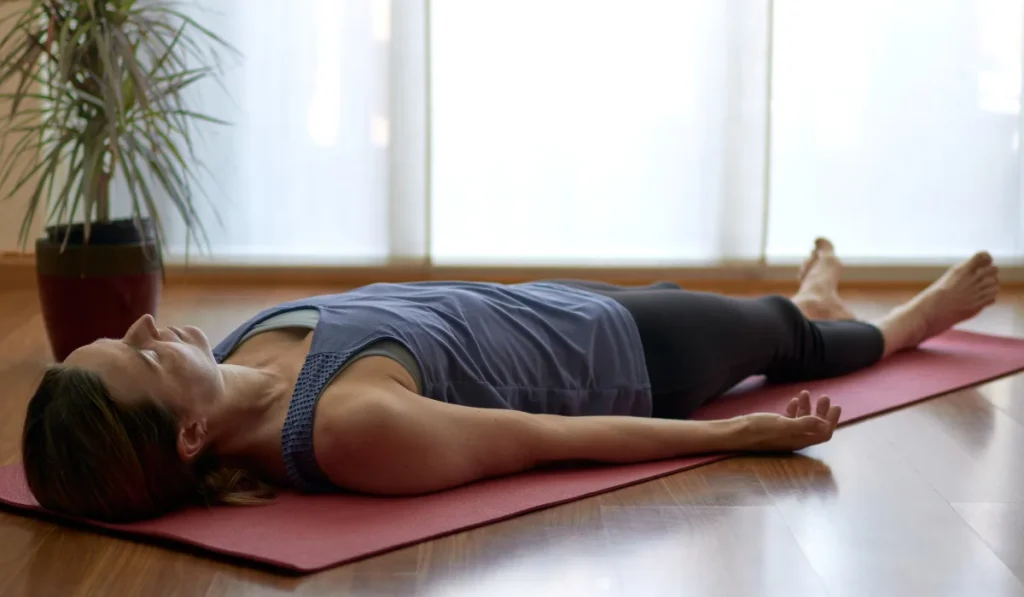
Often called “Yogic Sleep” or Non-Sleep Deep Rest (NSDR), Yoga Nidra is an ancient meditative practice that systematically leads you through the layers of the self. Unlike traditional meditation where you sit upright and focus, Yoga Nidra is practiced lying down in total comfort.
Yoga Nidra has undergone a fascinating evolution from an ancient spiritual practice to a modern “biohack” for insomnia and general nervous system regulation.
In its original context, Yoga Nidra was not a relaxation technique to help you fall asleep; it was a state of consciousness to be achieved while staying fully awake.
Today, Yoga Nidra is widely used as a therapeutic tool for the nervous system. The focus has moved from spiritual “awakening” to physiological “down-regulation”, my hope is that it can still be both – bridging what we need most to fully heal and be at peace: connection with our body, mind and spirit.
There is no “trying” involved. You simply follow the sound of my voice as we rotate consciousness through the body.

The Science: Beyond “Just Relaxing”
As a therapist, I find this practice fascinating because of what happens in the brain. During a session, we move through specific stages that shift your nervous system:
- The Beta to Alpha Shift: We move from the “active/stress” state into a relaxed, creative state.
- The Theta State: This is the “dream” state. Here, your body begins physical healing, and the “cortisol ” (stress hormone) in your system begins to drop.
- The Delta State: This is the deepest level of sleep, yet you remain conscious. It is here that we can access the subconscious mind to release long-held tension or trauma.
Why It’s a Game-Changer for Mental Health
Because Yoga Nidra works on a somatic (body) level, it bypasses the “thinking” brain. It allows your nervous system to feel safe—something that is often difficult to achieve through talk therapy alone.
30 minutes of Yoga Nidra has been shown to be as restorative as 2 to 4 hours of conventional sleep. It improves sleep quality, reduces anxiety, and helps regulate the emotional “alarm system” of the brain (the amygdala).
How to Begin
The best part? You cannot do it wrong. Even if you fall asleep (and I often do when listening to a guided Yoga Nidra!), your subconscious mind is still listening and receiving the benefits.
If you are feeling burnt out, over-stimulated, or simply disconnected from your body, I invite you to join me for a guided session. It’s time to stop trying to relax and start allowing your body to remember how to rest.
Check out 20 minute practice: Yoga Nidra for Deep Sleep and Full Body Reset
Or Visit Insight Timer Relaxing Mind, Body and Breath for Restful Sleep
Frequently Asked Questions about Yoga Nidra
1. Do I need to be flexible or have yoga experience?
Not at all. Despite the name, there are no physical postures. You will spend the entire session lying down in a position of total stillness. If you can lie on a mat or a bed, you can do Yoga Nidra.
2. What if I fall asleep?
Falling asleep is very common, especially if you are chronically sleep-deprived. The good news? Your subconscious mind is still awake and listening. You will still receive the physiological benefits of the nervous system “reset,” even if you don’t remember the verbal cues.
3. How is this different from a regular nap?
A nap often leaves you feeling “groggy” because you may wake up mid-cycle. Yoga Nidra keeps you in the “hypnagogic” state—the borderline between wakefulness and sleep. This allows for deep cellular repair while maintaining a trace of awareness, leaving you feeling clear-headed and refreshed rather than sleepy.
4. Can Yoga Nidra help with anxiety or trauma?
Yes. From a therapeutic perspective, Yoga Nidra helps down-regulate the sympathetic nervous system (the “fight or flight” response). By practicing “body sensing” and breath awareness in a safe environment, you teach your brain that it is safe to let go of hyper-vigilance.
5. What should I wear/set up?
Wear your most comfortable, loose-fitting clothes. Since the body temperature drops during deep relaxation, I recommend having a blanket, a small pillow for your head, and perhaps an eye mask to block out light. If you practice at bedtime and hope to fall asleep listening to a Yoga Nidra meditation, then get into bed as you would, making sure you are as comfortable as you can.